I didn’t have a “wow” moment where AI suddenly changed everything overnight.
What actually happened was quieter. I realised one week that I was making better decisions, faster, and with less friction than I had a year earlier. Not because I was smarter, but because AI was sitting inside my daily workflow, removing delays and blind spots.
That’s when it stopped being a content tool and became something far more useful.
What Actually Changed in Day-to-Day Work
Before AI, a lot of SME marketing was built around waiting.
Waiting for data to accumulate.
Waiting for reports to make sense.
Waiting for creative iterations to be written, reviewed, and tested.
Now, most of that waiting has gone.
Campaign planning that used to take days now happens in hours. Not because AI gives the “right” answer, but because it forces clarity earlier. I can pressure-test an idea before we spend a pound. I can see weak assumptions immediately instead of discovering them after launch.
That alone has saved clients more money than any clever automation.
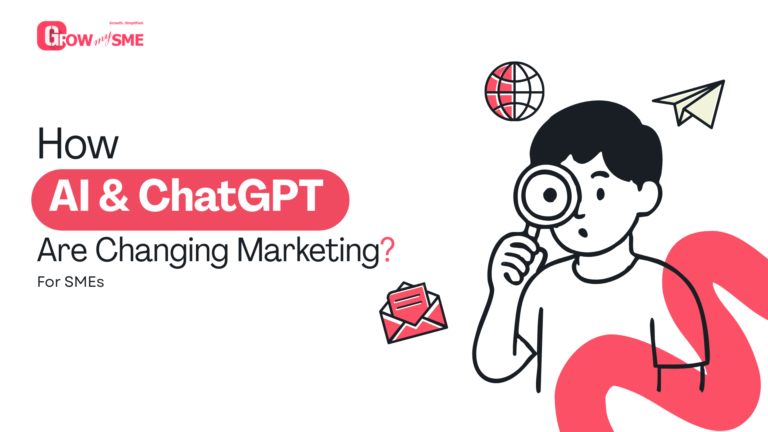
For many SME teams, this shift sits within a broader transformation in how AI and ChatGPT are changing marketing for SMEs, particularly in how quickly campaigns can be analysed and improved.
The Moment AI Became More Than a Content Tool
At first, I used ChatGPT like everyone else. Writing ads faster. Drafting emails. Speeding up content.
Useful, but not game-changing.
The shift came when I started using it before execution, not during. Feeding it past performance data, audience insights, failed experiments, and asking it to challenge my thinking rather than replace it.
That’s when testing velocity changed. We weren’t just producing more. We were killing bad ideas earlier and doubling down on good ones sooner.
For SMEs with limited budgets, that matters far more than fancy creative.
How Campaign Testing Looks Now
One thing I rarely do manually anymore is start from a blank page.
For ads, I’ll map the structure. The audience. The core objection. The angle we want to test. Then I use AI to generate variations within that framework.
Hooks. Opening lines. Different ways of framing the same pain point.
What surprised me was not how good the outputs were, but how quickly patterns emerged. You see what resonates within days instead of weeks because you’re testing properly, not guessing.
Understanding where those experiments should run is equally important. Many SMEs still perform best by focusing on proven platforms such as search, social, and professional networks, which is why identifying the top marketing channels for business growth remains essential before scaling experimentation.
AI didn’t make the ads better by default. It made the learning loop shorter.
Where AI Saves Time and Where It Causes Damage
AI is brilliant at removing busywork.
Drafting first versions.
Summarising performance.
Spotting obvious inconsistencies in funnels or messaging.
It’s terrible at judgement.
I’ve seen SMEs hand over entire email sequences or ad accounts to AI and wonder why conversions dropped. The messaging looked fine on paper, but it didn’t reflect how customers actually think or buy.
AI doesn’t understand commercial nuance. It doesn’t know when a lead is high intent but cautious, or low intent but emotional. It can’t feel brand trust eroding.
That still requires a human who understands the business.
Why AI Made Average Marketers Faster and Good Marketers Dangerous
This is the uncomfortable part.
AI hasn’t levelled the playing field. It’s widened the gap.
Average marketers now move faster, but often in the wrong direction. They produce more assets, launch more campaigns, and still struggle to scale profitably.
Good marketers use AI to think better. They test cleaner. They read results more honestly. They know when not to scale.
I’ve seen small teams outperform larger competitors simply because they learn faster. AI is the accelerator, not the engine.
The Mistake I See SME Founders Make Repeatedly
Over-trusting outputs.
Founders ask ChatGPT what ads to run, what funnels to build, what emails to send, and treat the response like strategy. When it doesn’t work, they blame the channel or the market.
AI doesn’t know your margins.
It doesn’t know your operational constraints.
It doesn’t know which customers you actually want more of.
Without context and direction, it confidently gives you generic answers at scale.
That’s not intelligence. That’s risk.
What I Will Never Fully Hand Over to AI
I won’t hand over positioning.
I won’t hand over budget decisions.
I won’t let AI decide what success looks like.
Those choices define whether a business grows sustainably or chases vanity metrics. AI can inform them. It can’t own them.
The moment you outsource judgement, performance becomes fragile.
What SMEs Should Actually Focus on in 2026
Not tools. Not trends.
Clarity.
Clear offers.
Clear economics.
Clear understanding of what drives conversion and retention.
Once that’s in place, AI becomes incredibly powerful. It removes friction, speeds up learning, and frees time to focus on strategy rather than execution.
But clarity also means understanding how marketing performance is evaluated. Too many businesses still focus on clicks or impressions instead of revenue, which is why learning how to measure marketing ROI properly remains one of the most valuable skills for SME founders.
Without that foundation, AI just helps you move faster into the wrong decisions.
What I Now Believe About AI in SME Marketing
AI isn’t the future of marketing. It’s the infrastructure.
The businesses that win won’t be the ones using the most automation. They’ll be the ones making the best decisions with it.
If I were advising a founder starting today, I’d say this: learn how your marketing actually works before you try to automate it. Use AI to sharpen thinking, not replace it.
Strategy still beats automation alone. It always has.
AI just makes that truth harder to ignore.