If your business is less than six months old and you are already obsessing over ROI, you are not alone. Almost every founder we speak to asks the same question within the first few weeks of running ads or publishing content:
“Is this actually working?”
The problem is not the question. The problem is the expectation behind it.
Most early-stage businesses are implicitly trying to measure marketing performance using benchmarks that only make sense for mature companies with years of data, stable demand, and proven funnels. Expecting clean, immediate ROI in the first 90 to 180 days is not realistic, and it often leads founders to make the wrong decisions too early.
This is not a theory. It is a pattern we have seen repeatedly while working with early-stage SMEs running their first Google Ads campaigns, testing Meta Ads, or investing in SEO before brand awareness exists.
ROI still matters. It just needs to be measured differently at the start.
Why Traditional ROI Metrics Fail for New Businesses
Most advice around marketing ROI assumes conditions that simply do not exist for new businesses. When those assumptions break down, the metrics become misleading.
You have no historical baseline
Established businesses can compare performance year-on-year or month-on-month. New businesses cannot. There is no benchmark to tell whether £50 per lead is expensive or cheap in your market yet.
Your tracking is rarely perfect
Early-stage tracking setups are often incomplete. Conversion events change, funnels evolve, and attribution windows are inconsistent. This makes revenue-based ROI calculations fragile and often inaccurate.
Your funnel is not optimised
Landing pages are new. Messaging is untested. Offer-market fit is still forming. If conversions are weak, it does not automatically mean the traffic is bad. It often means the system is immature.
Your brand has no trust yet
People are less likely to convert on the first visit when they have never heard of you. This affects paid ads, SEO, and content equally. Expecting immediate ROAS ignores the reality of trust-building.
In short, traditional ROI metrics assume stability. Early-stage businesses are still in discovery mode.
What “ROI” Really Looks Like in the First 6 Months
In the early stages, ROI is less about extracting profit and more about validating signals.
The most important shift founders need to make is moving from lagging indicators to leading indicators.
Lagging indicators tell you what already happened. Revenue, ROAS, and profit fall into this category.
Leading indicators tell you whether you are moving in the right direction. These are far more valuable early on.
At this stage, ROI looks like:
- Paying to learn what actually converts
- Identifying which audiences respond, and which do not
- Improving efficiency before increasing spend
- Building signal strength, not volume
This is why we often talk about cost per learning, not just cost per sale. If a campaign produces clear insights about messaging, intent, or user behaviour, it has value even if revenue is inconsistent initially.
The Right Metrics to Track Instead of Pure Revenue
Revenue will come later. In the first six months, these metrics tell you far more about future ROI.
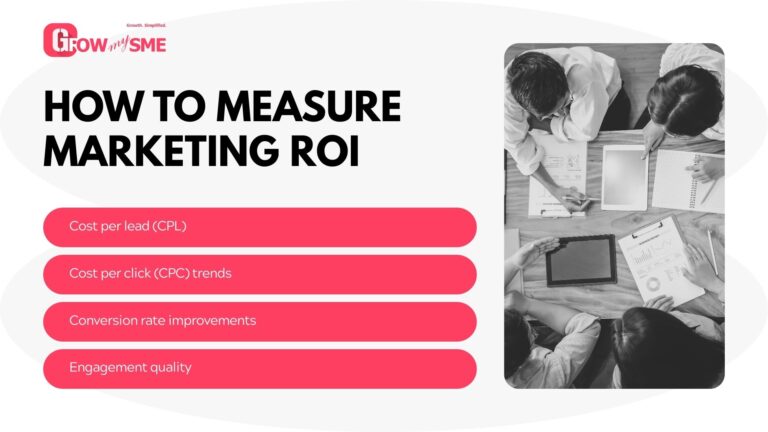
Cost per lead (CPL)
Not as a fixed target, but as a directional metric. Is CPL trending down as targeting, messaging, and landing pages improve?
Cost per click (CPC) trends
Rising CPCs can signal poor relevance or weak ad messaging. Stable or improving CPCs suggest growing alignment between ads and audience intent.
Conversion rate improvements
Even small increases matter early on. A landing page moving from 1% to 2% conversion rate doubles future ROI potential before you spend another pound.
Engagement quality
Time on page, scroll depth, form completion rates, and return visits all indicate whether the right people are entering your funnel.
Funnel drop-off points
Where are users leaving? On the page, at the form, or after the first email? These insights often matter more than headline performance numbers.
Audience data insights
Which search terms, demographics, job titles, or interests show intent? This data compounds over time and directly improves future efficiency.
This is how early-stage marketing performance should be evaluated. Not in isolation, but as a system learning exercise.
How to Attribute Value When Sales Are Inconsistent
Attribution is one of the biggest sources of frustration for new founders.
Someone clicks an ad, leaves, comes back via Google, signs up to an email list, then converts two weeks later. Which channel gets the credit?
The honest answer is: none of them fully.
Early-stage attribution is directional, not exact.
Instead of obsessing over last-click attribution, smart founders look at:
- Assisted conversions across channels
- First-touch signals that start the journey
- Patterns over time, not single conversions
A Google Ad that introduces the brand may not close the sale, but it can be the reason future traffic converts faster. Ignoring that value leads to underinvestment in channels that actually drive growth.
The Biggest Mistakes New Businesses Make When Measuring ROI
We see these mistakes repeatedly in early-stage SMEs.
Killing campaigns too early
Turning off campaigns after two or three weeks because ROI is unclear almost guarantees failure. Learning requires data.
Chasing vanity metrics
High impressions or low CPCs mean nothing if engagement quality is poor. Visibility without intent is not progress.
Switching strategy every few weeks
Constant resets prevent data from compounding. Consistency creates clarity.
Hiring agencies that promise instant ROAS
Anyone guaranteeing fast returns for a brand-new business is either inexperienced or being dishonest about risk.
These mistakes do not just waste money. They slow learning and delay profitability.
What Smart Founders Do Differently
Founders who build profitable marketing systems early share a few behaviours.
They treat marketing as an investment phase, not a cost centre.
They prioritise data quality and clarity before scaling spend.
They focus on repeatable systems, not tactics or hacks.
Most importantly, they understand that early-stage marketing ROI is about building leverage. Once the signals are clear, scaling becomes far safer and far more profitable.
How Grow My SME Approaches Early-Stage ROI
At Grow My SME, we do not judge early-stage marketing by surface-level ROAS alone. That approach breaks more businesses than it helps.
Our methodology focuses on:
- Clear measurement frameworks from day one
- Realistic benchmarks based on stage, not hype
- Transparent reporting that explains what the data actually means
- Building foundations that support future scale, not just short-term wins
We work with founders who want clarity, not comfort. The goal is not to make reports look good. The goal is to build marketing systems that become predictably profitable over time.
ROI Is Still Measurable. Just Not the Way You Were Told
If your business is under six months old, marketing ROI is not a myth. It is simply misunderstood.
The early phase is about learning efficiently, validating demand, and improving systems. When those pieces are in place, revenue follows with far less friction.
If your business is under six months old and you want to measure marketing the right way, Grow My SME helps founders build profitable systems, not just campaigns.